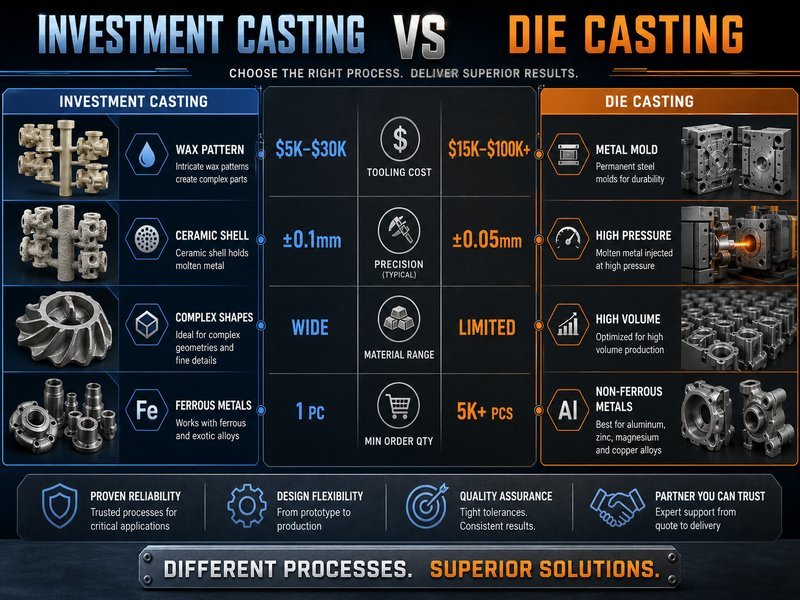
Investment casting and die casting differ primarily in cost structure and production method: investment casting uses disposable molds for high precision and complex parts at lower volumes, while die casting uses permanent metal molds for high-speed, high-volume production at lower per-unit cost.
Investment casting, also known as lost-wax casting, is a precision manufacturing process where a wax pattern is coated with a ceramic shell to create a mold. Once the wax is melted out, molten metal is poured into the cavity to form the final part.
This process is widely known for its ability to achieve tight tolerances (typically ±0.1 mm per 25 mm) and excellent surface finish without extensive machining. Because the mold is broken after each casting, it allows for extremely complex geometries, including internal cavities, thin walls, and undercuts that are difficult or impossible with other casting methods.
Investment casting is especially suitable for:
Die casting is a high-speed manufacturing process where molten metal is injected into a hardened steel mold (die) under high pressure. The metal solidifies quickly, producing parts with excellent dimensional accuracy and smooth surface finishes.
Unlike investment casting, die casting uses reusable molds, which significantly increases upfront tooling costs but dramatically reduces per-part cost at scale. The process is highly automated and optimized for mass production.
Die casting is best suited for:
| Factor | Investment Casting | Die Casting |
|---|---|---|
| Tooling Cost | $5K–$30K | $15K–$100K+ |
| Cost per Part (500 units) | $15–40 | $30–80 |
| Cost per Part (10K units) | $5–15 | $2–8 |
| Minimum Order Quantity | 1–100 units | 5K–10K units |
| Lead Time | 2–6 weeks | 6–16 weeks |
| Tolerance | ±0.1 mm / 25 mm | ±0.05 mm / 25 mm |
| Surface Finish | Ra 1.6–3.2 μm | Ra 0.8–1.6 μm |
| Material Range | Steel, stainless steel, bronze, aluminum | Aluminum, zinc, magnesium |
| Max Part Weight | Up to 500 kg | Typically <30 kg |
| Design Complexity | High (internal cavities, undercuts) | Medium (requires draft angles) |
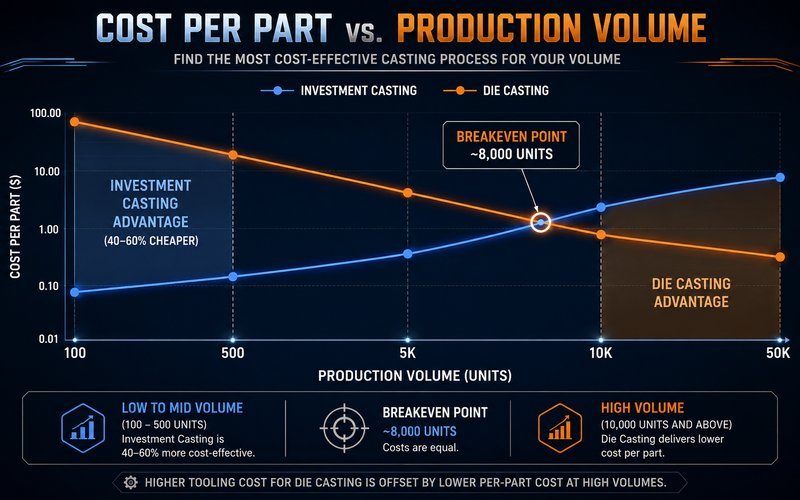
The cost difference between investment casting and die casting largely depends on production volume due to tooling amortization.
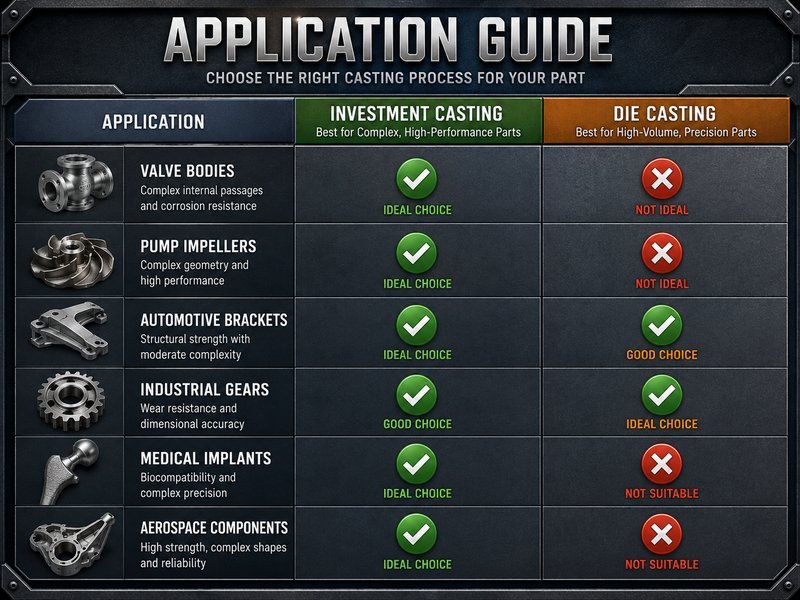
Investment casting is the better option when flexibility, complexity, and material variety outweigh production speed.
This makes it especially popular in industries like oil & gas, industrial valves, medical devices, and aerospace.
Die casting excels in environments where speed, consistency, and cost efficiency at scale are critical.
For example, aluminum enclosures, automotive brackets, and consumer hardware are commonly die-cast due to their high production volumes.
Sand casting is another widely used method that sits between investment casting and die casting in terms of cost and capability.
Comparison overview:
For example, a large pump housing may be sand-cast for cost reasons, while smaller precision valve components are investment-cast.
The main difference lies in tooling and volume. Investment casting has lower upfront tooling costs, making it more economical for low to medium volumes. Die casting requires expensive molds but delivers much lower per-unit costs at high production volumes.
Die casting can achieve slightly tighter tolerances and better surface finishes, but it is more limited in geometric complexity. Investment casting offers greater design freedom, especially for internal features and intricate shapes.
For most industrial valve components, investment casting is the preferred choice due to its ability to handle stainless steel, complex internal geometries, and corrosion-resistant materials. Die casting is generally not suitable unless the valve is made from aluminum and produced in very high volumes.
Send your part drawings or specifications — our engineering team responds within 24 hours with a detailed quote and process recommendation.