Valve engineers and procurement teams need more than a material list. They need a practical framework that links process capability, ASTM material grades, pressure testing standards, and end-use service conditions. This guide connects those decisions into one selection path.
Matson Foundry is an ISO 9001 certified precision investment casting facility exporting cast valve components worldwide for oil and gas, chemical processing, water treatment, and general industrial systems.
Direct Answer: Investment casting for valve parts produces near-net-shape components in materials from CF8M stainless (most common) to WCB carbon steel and duplex grades, meeting ASTM A351, A216, and A217 standards. Valve castings are used across oil and gas (API 6A, NACE compliant), water treatment, chemical processing, and HVAC industries. Investment casting delivers tight dimensional control (CT5-CT7), thin walls (1.5-3 mm), excellent surface finish (Ra 3.2-6.3 um), and reduces machining compared to sand-cast alternatives.
Investment casting is often the most efficient route for complex valve components because it combines geometry freedom with repeatable quality. Valve bodies, bonnets, yokes, and trim supports usually include intersecting flow passages, flange transitions, and sealing-related contours that are expensive to manufacture from forged blocks. By producing these features near net shape, the process cuts machining time, lowers material waste, and keeps weight under control while still meeting pressure-retaining requirements.
The process advantage becomes more visible when valve parts include curved flow paths or mixed section thickness. Sand casting can create the general envelope, but investment casting typically delivers finer surface finish and tighter dimensional control, reducing finishing operations. Forgings remain strong for many duty classes, but for medium and high-complexity geometries the total cost of forging plus heavy machining can exceed investment-cast solutions at comparable quality levels.
Procurement teams also benefit from process consistency. With stable wax tooling, controlled shell build, and disciplined melt practices, investment casting supports predictable repeat batches. That consistency helps reduce downstream variation in CNC setup, pressure testing, and assembly. For OEM programs that ship globally, this repeatability supports qualification maintenance and supplier risk control over multi-year production windows.
When evaluating new projects, start with service condition first and process second. If the component needs complex geometry, high repeatability, and a broad alloy portfolio from carbon steel to duplex, investment casting is usually the practical baseline. Explore our valve casting product line and capabilities.
Material selection controls corrosion resistance, pressure-temperature envelope, weldability, and long-term reliability. For valve castings, engineers usually map materials by three dimensions: media chemistry, operating temperature, and required mechanical strength. The common mistake is choosing by nominal alloy family only, without validating casting grade standards and heat treatment requirements. A reliable decision sequence is: define service profile, shortlist alloy families, verify standard grade availability in cast form, then align inspection and test plans.
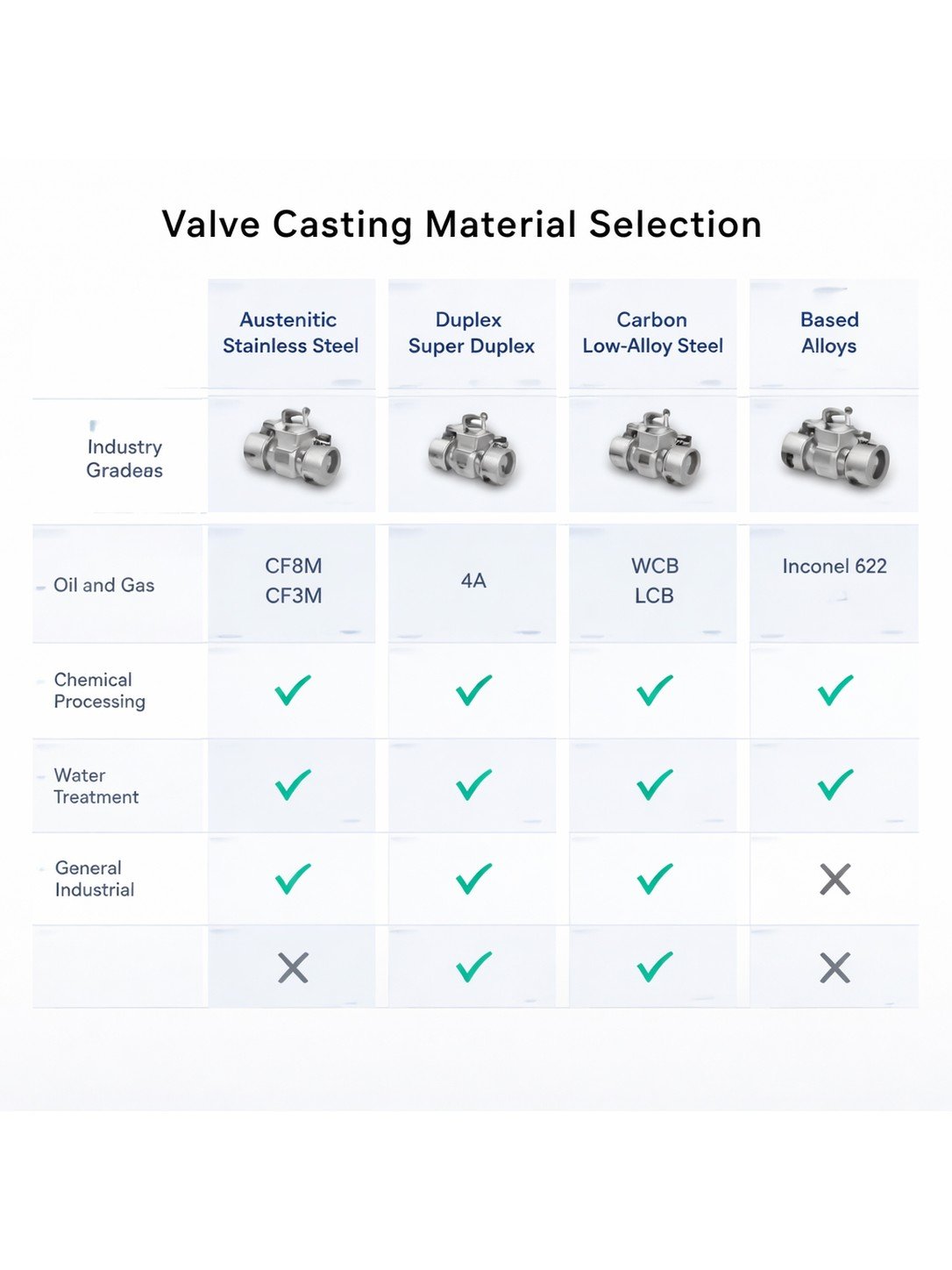
Austenitic stainless castings remain the most widely used family for industrial valve bodies and bonnets. CF8 and CF8M (ASTM A351) are common because they balance corrosion resistance and manufacturability across water, mild chemical, and general process services. CF8M, equivalent to cast 316 chemistry, is often selected when chloride exposure or broader corrosion margin is needed. These grades also support strong global supply coverage, which helps procurement teams stabilize lead time and sourcing strategy.
From a manufacturing perspective, austenitic grades are casting-friendly for medium-complexity valve components, but they still require process discipline to control shrinkage-related defects in heavy sections. For sealing interfaces, seat pockets, and flange faces, machining allowance must be planned because pressure-tight performance depends on post-cast finish quality, not only as-cast dimensions. Learn about our stainless steel casting capabilities.
Duplex families, such as ASTM A995 grades, provide a combined strength-corrosion profile that is valuable in aggressive chloride environments. They are widely used for seawater systems, offshore topside equipment, and selected chemical services where pitting resistance and stress corrosion cracking performance are critical. Super duplex grades extend that capability but require tighter foundry control on composition, ferrite-austenite balance, and heat treatment to maintain mechanical and corrosion properties.
Because duplex metallurgy is sensitive to thermal history, supplier qualification matters more than nominal grade naming. Procurement managers should request evidence of controlled melt practice, heat treatment records, ferrite checks, and corrosion-related test references where applicable. Duplex can reduce lifecycle failure risk, but only when process capability is proven and inspection discipline is explicit.
Carbon steel castings such as WCB (ASTM A216) remain core materials for many pressure-containing valves in oil and gas, steam, and general industrial service where corrosion exposure is manageable. They offer cost-effective strength and broad manufacturability. For higher temperature or enhanced mechanical requirements, low-alloy cast steels under ASTM A217 are frequently applied. These grades support demanding duty conditions while maintaining castability for complex body geometry.
In practical purchasing decisions, carbon and low-alloy selections should include coating strategy, corrosion allowance assumptions, and expected maintenance cycles. Teams that evaluate only initial casting cost often underestimate long-term field exposure impact. Material choice should be tied to real service chemistry and inspection frequency, not generic specification templates. Alloy steel casting specifications for high-temperature service.
Nickel-based cast alloys under ASTM A494 are used when severe corrosion, elevated temperature, or combined attack mechanisms exceed stainless and duplex capability. Typical severe-service valve applications include concentrated chemical streams, high-temperature corrosive systems, and specific sour environments with strict integrity targets. These alloys carry higher raw material and processing cost, but they can provide the most stable lifecycle economics when shutdown risk is high.
For procurement, nickel-alloy decisions should include not only material price but also qualification depth: foundry melting controls, traceability, weld repair limits, and inspection scope. In critical services, robust documentation and predictable metallurgy often matter more than nominal lead-time advantage from unqualified sources.
Standards alignment is the foundation of cross-team communication between engineering, quality, and procurement. ASTM material standards define chemistry, mechanical properties, and heat treatment expectations for cast grades; they are not optional documentation details. Selecting a grade name without confirming the governing ASTM specification can lead to mismatched test reports, delayed approvals, and field risk.
For most cast valve components, engineers routinely reference ASTM A351 (austenitic stainless castings), ASTM A216 (carbon steel castings for high-temperature service), ASTM A217 (low-alloy steel castings), ASTM A995 (duplex stainless steel castings), and ASTM A494 (nickel alloy castings). These standards should be paired with product-level and service-specific requirements where relevant, including API and NACE references.
| Standard | Typical valve casting scope | Common grade examples |
|---|---|---|
| ASTM A351 | Austenitic stainless valve bodies, bonnets, and covers | CF8, CF8M, CF3M |
| ASTM A216 | Carbon steel castings for pressure-containing components | WCB, WCC, WCA |
| ASTM A217 | Low-alloy steel castings for higher temperature service | WC6, WC9, C5 |
| ASTM A995 | Duplex and super duplex castings for corrosive service | 4A, 5A, 6A |
| ASTM A494 | Nickel alloy castings for severe corrosion and temperature | M35-1, N12MV, CZ100 |
Material standards should be integrated with final acceptance criteria. Pressure testing standards such as API 598 and ISO 5208 define leakage classes and test methods that validate manufacturing quality on finished valves. Surface quality references like MSS SP-55 and dimensional tolerance frameworks such as ISO 8062 provide additional consistency for visual and dimensional acceptance language. Together, these standards create a complete technical contract from melt to shipment.
No single alloy is best for every valve configuration. Material suitability depends on pressure class, media, temperature cycling, and shutoff requirements. A practical matrix helps teams avoid overspecification and underperformance.
| Valve category | Typical service profile | Recommended casting material range |
|---|---|---|
| Gate and globe valves | Pressure-bearing isolation/control in process lines | WCB/WC6 for high-temperature duties; CF8M for corrosive media |
| Ball valves | Tight shutoff and broad chemical compatibility | CF8M/CF3M for corrosion; duplex for chloride-rich service |
| Check valves | Flow-direction control with impact and cycle loading | WCB for utility service; stainless for corrosive and sanitary applications |
| Control valve bodies | Continuous throttling with erosive/corrosive exposure | A217 low-alloy or A494 nickel alloy in severe service |
The matrix should always be validated against plant-specific conditions, including upset events. Engineers should include transient temperature, cleaning chemistry, and startup-shutdown cycles in the final material review, because those conditions often drive failures that steady-state calculations miss.
Industry context determines what "best material" actually means. The same valve geometry may require very different casting grade and inspection strategy depending on service chemistry, regulatory requirements, and reliability targets.
Upstream and midstream applications demand strict pressure integrity and corrosion management. Components may require compatibility with API 6A frameworks and NACE MR0175 / ISO 15156 for sour service environments. Material decisions often balance sulfide stress cracking resistance, strength class, and field maintainability. In this segment, supplier qualification, traceability depth, and test discipline are as critical as nominal alloy selection. Investment casting applications in oil and gas industry.
Water systems prioritize corrosion resistance, lifecycle reliability, and cost stability across high-volume installations. Austenitic stainless castings are common in aggressive or variable chemistry systems, while carbon steel options may remain suitable in controlled, coated environments. Procurement teams often prioritize standardization to simplify spare strategy across plant networks.
Chemical processing introduces wide corrosion profiles and thermal cycling that quickly expose weak material assumptions. CF8M and duplex grades cover many process lines, but concentrated chemistries or elevated-temperature corrosive media can push selection toward nickel-based cast alloys. A robust selection process includes corrosion review, process upset scenarios, and valve trim compatibility, not only body material checks.
HVAC and general industrial systems often prioritize value, availability, and maintainability. WCB and stainless castings both remain practical depending on fluid quality and operating envelope. In this segment, investment casting creates value through near-net geometry that reduces machining cost while preserving dimensional consistency for assembly-scale production.
Investment casting is a near-net process, not a no-machining process. Teams that define tolerances correctly at design stage improve both yield and downstream assembly performance. In most programs, as-cast tolerances follow ISO 8062 capability levels (commonly CT5-CT7 for relevant geometry ranges), while sealing and datum-critical surfaces are machined to final specification. Design rules for cast valve components are covered in our investment casting design guide.
Leak-tight performance is validated on finished valve assemblies using standards such as API 598 and ISO 5208. These tests confirm shell integrity and seat leakage performance under controlled pressure conditions. From a foundry and machining standpoint, the implication is clear: cast geometry must provide sufficient stock and datum stability for precise finishing of seat bores, flange faces, and stem interfaces where shutoff performance is determined.
ISO 8062 gives a structured approach to casting tolerance grades, allowing engineering and purchasing teams to align dimensional expectations with realistic process capability. MSS SP-55 supports visual quality language for steel casting surfaces, helping reduce subjective inspection disputes between supplier and buyer. Combined use of these references improves drawing clarity and acceptance consistency.
Typical investment casting surfaces can achieve roughly Ra 3.2-6.3 um depending on geometry and alloy. Thin walls down to approximately 1.5-3.0 mm are feasible in many designs, though pressure-retaining valve bodies commonly use thicker practical sections. For critical geometry, specifying machining stock and datum strategy during RFQ stage prevents late-stage redesign and avoids unnecessary scrap.
Choosing a valve casting partner is not only a price decision. It is a risk management decision across metallurgy, process control, machining integration, and documentation quality. A strong supplier should demonstrate consistent control from wax tooling to final inspection and provide evidence that standards are applied as operating practice, not only as brochure claims.
Start with capability alignment: can the foundry regularly produce your targeted alloy family, section complexity, and testing scope? Next, validate quality infrastructure: ISO 9001 status, heat treatment control, NDT capability, dimensional inspection process, and traceability. Then review execution reliability: engineering response speed, DFM support, lead-time realism, and change-control discipline.
For global procurement teams, communication quality is also a technical variable. Clear technical review, transparent nonconformance handling, and stable export documentation reduce project friction and accelerate approval cycles. The right partner helps your engineering and sourcing teams make faster, lower-risk decisions from prototype through serial production.
CF8M (316 stainless steel equivalent per ASTM A351) is the most widely used material for valve bodies in corrosive environments. It offers excellent corrosion resistance, good mechanical properties, and is suitable for a broad range of pressures and temperatures.
Key ASTM standards include A351 (austenitic stainless steel castings), A216 (carbon steel castings for high-temperature service), A217 (low-alloy steel castings), A995 (duplex stainless steel castings), and A494 (nickel alloy castings).
As-cast investment cast valve components typically achieve ISO 8062 CT5-CT7 tolerances on general dimensions. Critical sealing surfaces, seat bores, and flange faces still require CNC machining to achieve the tight tolerances needed for bubble-tight shut-off per API 598 or ISO 5208 testing.
Yes. Many API 6A valve body, bonnet, and trim components are produced by investment casting in materials compliant with NACE MR0175/ISO 15156 for sour service, provided the foundry follows appropriate material and testing protocols.
Investment casting can produce valve walls as thin as 1.5-3.0 mm depending on material, with typical valve body wall thicknesses in the 4-12 mm range. Thin wall capability reduces weight and material cost compared to sand casting or forging, without compromising pressure integrity.
Share your drawing package, service condition, and target standards. Our team will recommend material routes and process windows aligned to your valve program.