A practical comparison of two very different ways to make a metal part — pouring a near-net shape versus cutting it from solid — covering cost, tolerance, material use, lead time, and the hybrid approach most production parts actually use.
Direct answer: Investment casting and CNC machining solve the same part differently. Investment casting pours a near-net-shape part from a one-time ceramic mold — low material waste, complex geometry, and lowest cost per part once volumes pass roughly 50–200 pieces. CNC machining cuts each part from solid stock to tighter tolerances (±0.025 mm) with no tooling, best for prototypes, low volumes, and critical precision features. Most production parts use both: cast the shape, then machine the critical surfaces.
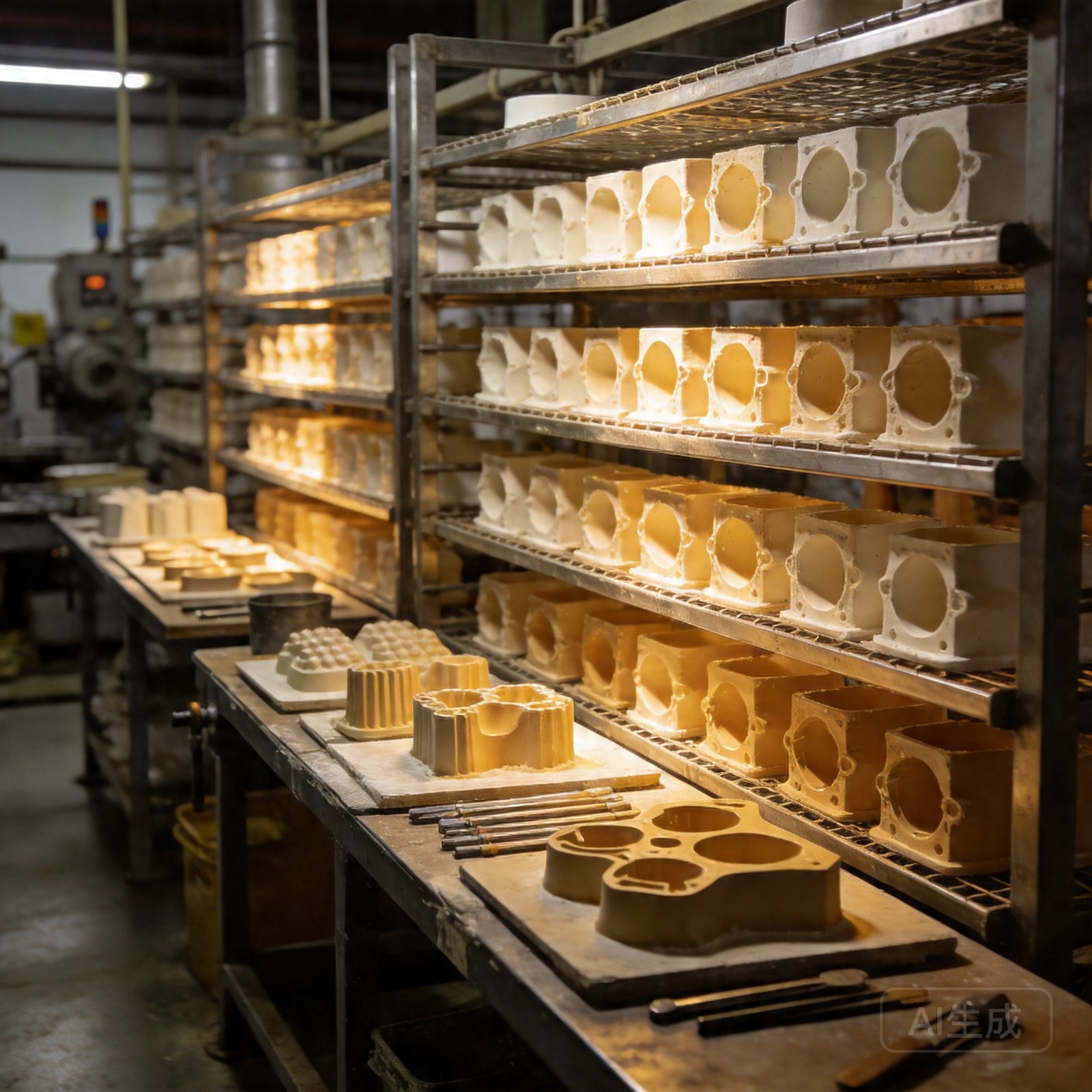
Investment casting (also called lost-wax casting) is an additive-then-formative process: a wax pattern is built, coated in a ceramic shell, melted out, and the cavity filled with molten metal. The part comes out close to its final shape — "near net shape" — so little material has to be removed afterward. It excels at complex geometries, internal passages, and thin walls that would be slow or impossible to machine.
CNC machining is a subtractive process: a computer-controlled tool cuts the part out of a solid block or bar. Every feature is created by removing material, which gives extremely tight tolerances and excellent surface finish but generates chips (waste) and takes longer as the part gets more complex.
| Factor | Investment Casting | CNC Machining |
|---|---|---|
| Typical tolerance | ±0.1–0.5 mm (CT4–CT7) | ±0.025–0.13 mm (to ±0.005 mm critical) |
| Surface finish (Ra) | 1.6–3.2 µm (63–125 µin) | 0.4–1.6 µm, finer with finishing passes |
| Tooling cost | Wax die: ~$2,000–$20,000+ | None (standard tools/fixtures, ~$100s) |
| Per-part cost at volume | Drops sharply with quantity | Roughly flat regardless of quantity |
| Material waste | Low (near net shape) | High (chips removed from solid) |
| Geometry complexity | Excellent — cavities, thin walls, undercuts | Limited by tool access and setups |
| Lead time | Tooling lead up front, then fast | Shortest for one-offs / prototypes |
| Volume sweet spot | Medium-to-high (~50–200+ pieces) | Low volume, prototypes, critical features |
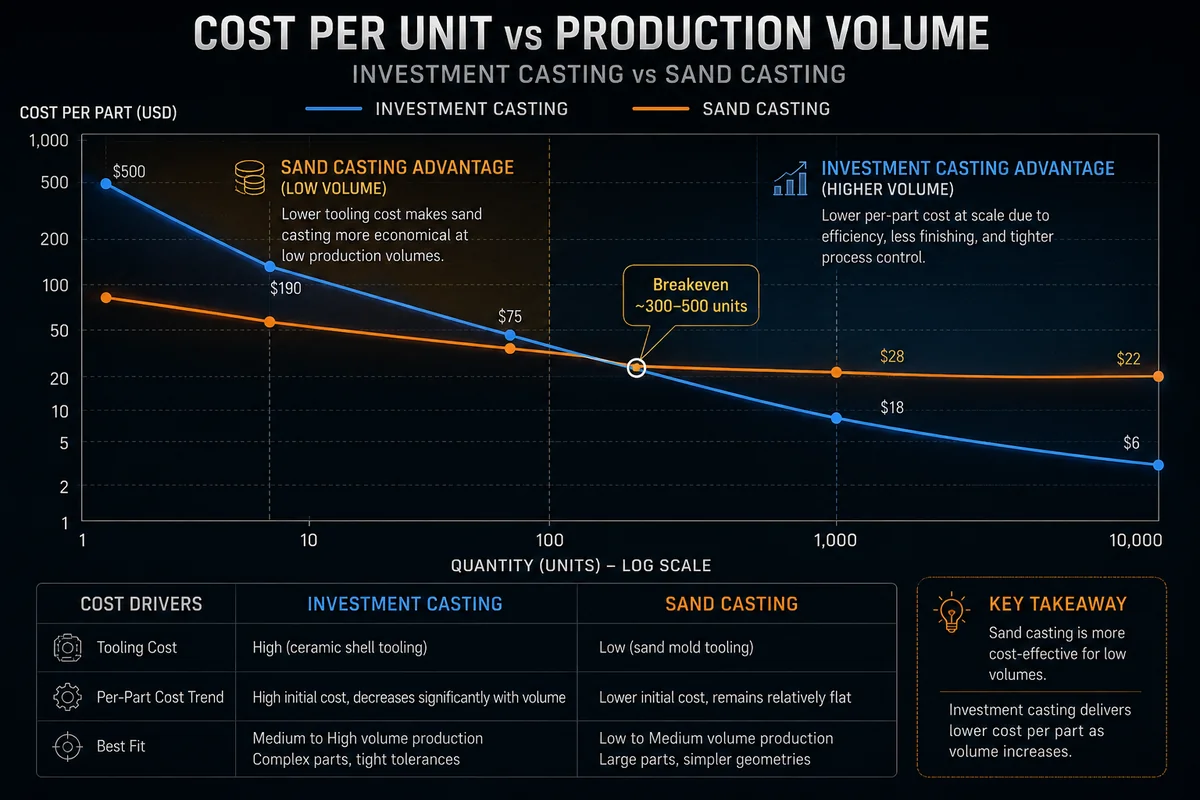
The single biggest driver is quantity. CNC machining starts cheap because there is no tooling — you pay for machine time and material from part one. Investment casting carries an up-front tooling cost (the wax die), so the first parts are expensive, but each additional casting is inexpensive once that tool is paid off.
For 1–10 parts, CNC almost always wins. As quantity climbs, the casting tooling is amortized across more parts and the per-part cost falls below CNC. The break-even typically lands around 50–200 pieces, depending on part size, complexity, and how much machining the casting still needs. Above that, casting's cost advantage widens quickly.
A simple way to picture it. Take a mid-size stainless bracket. Machined from solid, each piece might cost on the order of $50–$500 in machine time and material — and that number barely moves whether you buy 5 or 500, because every part is cut individually. Investment-cast, the same part carries a one-time tooling charge plus a low per-piece price; early parts look expensive, but by a few hundred units the per-part cost can fall to a fraction of the machined price. The more parts you need — and the more complex the shape — the more decisively casting wins. The fewer you need, the more machining's zero-tooling head start matters.
Two adjustments shift the break-even: a part that still needs heavy machining after casting pushes the break-even higher (you pay for both processes), while a highly complex part that machines slowly from solid pulls it lower (casting's near-net shape avoids that machining entirely).
If your print calls for tolerances tighter than about ±0.1 mm on a specific feature, that feature will need machining no matter which primary process you choose. Investment casting holds roughly ±0.1–0.5 mm as-cast (CT4–CT7 per ISO 8062) with a 1.6–3.2 µm surface — good enough that many cast features ship without machining. CNC reaches ±0.025–0.13 mm routinely and ±0.005 mm on critical features, with a finer finish.
The practical rule: let casting carry the general shape and non-critical surfaces, and reserve machining for sealing faces, bores, threads, and mating features that must be precise.
Investment casting only melts the metal it needs, so material utilization is high and complex internal geometry is essentially "free" — cavities, thin walls, and undercuts form in the mold. CNC machining starts from a larger solid and cuts the shape out, so complex parts mean more removed material, more tool changes, and more setups. For an intricate stainless or alloy-steel part in any real quantity, casting the shape is usually both cheaper and faster than machining it from bar.
Material choice also interacts with process. Hard, tough, or work-hardening alloys (duplex stainless, high-nickel grades, tool steels) are slow and tool-intensive to machine but pour readily in investment casting, widening casting's advantage. Conversely, free-machining alloys and simple prismatic shapes narrow it.
Lead time and volume often decide the call before cost does. CNC machining has no tooling step, so a first article or prototype can be in hand in days — ideal when a design is still changing or a sample is needed fast. Investment casting front-loads tooling: building the wax die and proving the first castings takes longer, but once that tool exists, repeat orders are quick and inexpensive.
That makes the two processes complementary across a product's life. Many parts start on CNC for prototyping and the first low-volume orders, then transition to investment casting once the design freezes and volumes justify the tooling. If you expect ongoing or growing demand, paying for casting tooling early lowers total cost over the production run; if demand is one-off or uncertain, machining avoids committing to a tool you may never amortize.
Use this checklist to point your part at the right primary process before you ask for quotes.
Lean toward CNC machining when:
Lean toward investment casting when:
Real selection is part-specific. A few patterns we see often:
Matson Foundry runs both in-house, so the recommendation follows the part rather than the equipment we happen to own — see our investment casting and CNC machining capabilities.

In practice these are rarely either/or. The most cost-effective route for precision production parts is to investment-cast the near-net shape and CNC-machine only the critical features. You get casting's low material cost and geometry freedom plus machining's precision exactly where the drawing demands it — cutting per-part cost while meeting tight tolerances on sealing faces and bores. This is how most cast valve bodies, pump components, and industrial parts are actually finished.
It depends on volume. Below roughly 50 parts, CNC machining is usually cheaper because there is no tooling to amortize. Above about 100–200 parts, investment casting typically wins: once the wax die and ceramic shell costs are spread across the run, per-part cost drops sharply while CNC cost stays nearly flat.
No. As-cast investment-casting tolerances run about ±0.1–0.5 mm, while CNC machining reaches ±0.025–0.13 mm and as tight as ±0.005 mm on critical features. Castings that need tight tolerances on specific surfaces are CNC-finished on those features only.
To get economy and precision together. Investment casting produces the near-net shape — saving material and machining time — and CNC then machines only the critical sealing faces, bores, or threads. This cuts per-part cost while still hitting tight tolerances exactly where they matter.
Investment casting handles any pourable alloy: stainless steel, carbon and alloy steel, bronze, and high-temperature superalloys. CNC machining cuts almost any solid material — metals, plastics, composites — but removes (and wastes) more material on complex shapes.
CNC machining has the shortest lead time for one-offs and prototypes because there is no tooling. Investment casting needs tooling lead time up front, but once the mold exists it delivers parts faster and far cheaper as volume rises.
Send us your drawing and target volume. Our engineers will tell you whether investment casting, CNC machining, or a hybrid of both gives you the lowest landed cost at your tolerance.